> ## Documentation Index
> Fetch the complete documentation index at: https://docs.katakate.org/llms.txt
> Use this file to discover all available pages before exploring further.
# Quickstart
> Install k7, prepare your node, start the API, and run your first sandbox
Katakate (k7) lets you run secure, lightweight VM sandboxes backed by Kata Containers and Firecracker, orchestrated with Kubernetes. This Quickstart gets you from zero to a working sandbox via CLI and Python SDK.
If you already installed k7 previously, consider running `make uninstall` before reinstalling to avoid stale cached files in a previous `.deb`.
## Requirements
* Linux (amd64) host with hardware virtualization (KVM)
* Check: `ls /dev/kvm` should exist
* Cloud guidance: AWS `.metal`, GCP (enable nested virtualization), Azure D/Ev series; typical VPS often lack KVM
* One raw, unformatted disk for thin‑pool provisioning (recommended for many sandboxes)
* Docker with Compose plugin (for the API)
* Install Docker: `curl -fsSL https://get.docker.com | sh`
* Ansible for the installer (Ubuntu):
```bash theme={null}
sudo add-apt-repository universe -y
sudo apt update
sudo apt install -y ansible
```
* Python 3.10+ on the client for the SDK
Tested setup example: Hetzner Robot instance, Ubuntu 24.04 (x86\_64), with an extra empty NVMe disk (for the thin‑pool). See the detailed setup guide (PDF): k7\_hetzner\_node\_setup.pdf.
## Install the CLI (APT)
Install the `k7` CLI on the node(s) that will host the VM sandboxes:
```bash theme={null}
sudo add-apt-repository ppa:katakate.org/k7
sudo apt update
sudo apt install k7
```
## Install K7 on your node(s)
This installs and wires up Kubernetes (K3s), Kata, Firecracker, Jailer, and the devmapper snapshotter with thin‑pool provisioning:
```bash theme={null}
k7 install
```
 You should see "Installation completed successfully!" when done. Add `-v` for verbose output.
## Start the API and manage keys
### Start the API
```bash theme={null}
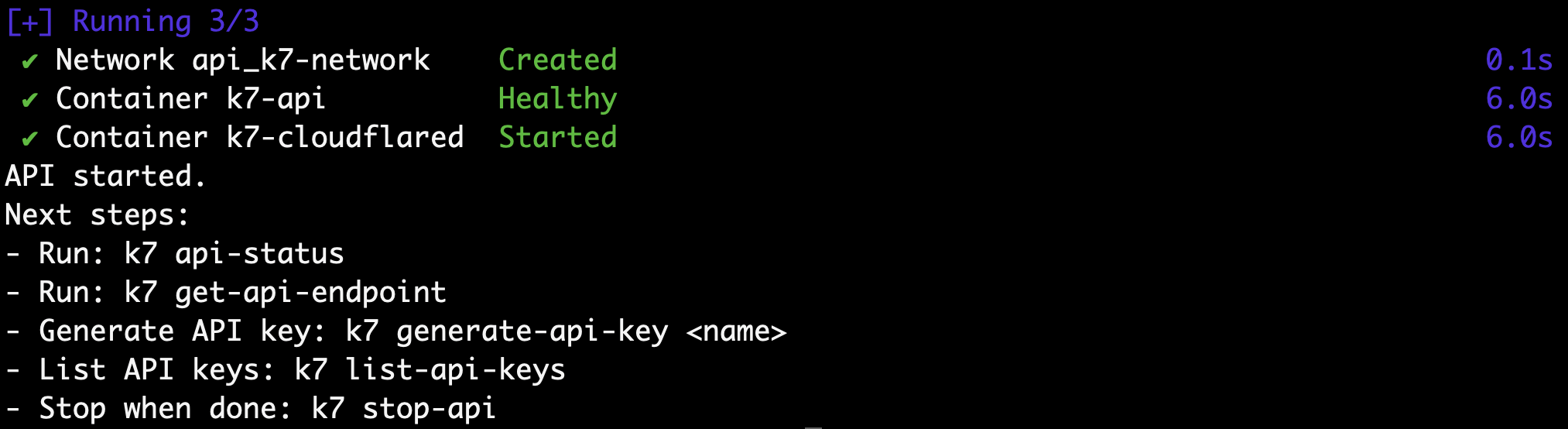
k7 start-api
```
You should see "Installation completed successfully!" when done. Add `-v` for verbose output.
## Start the API and manage keys
### Start the API
```bash theme={null}
k7 start-api
```
 ### Check API status
```bash theme={null}
k7 api-status
```
### Check API status
```bash theme={null}
k7 api-status
```
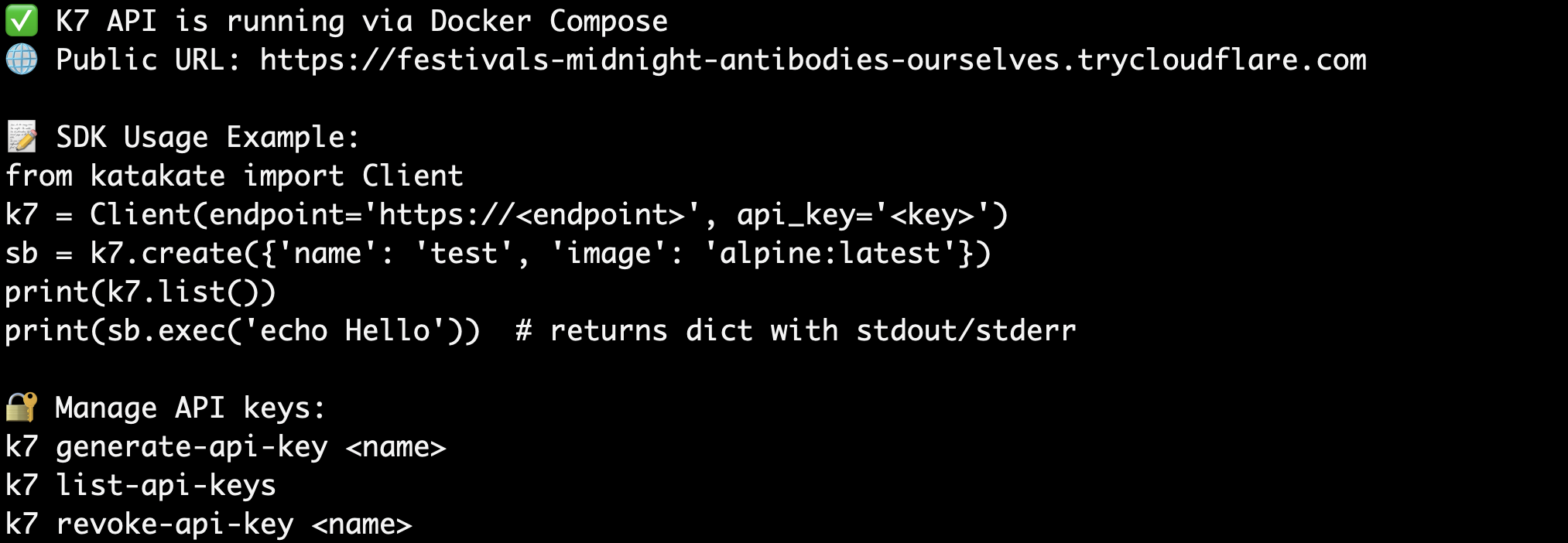 ### Get the public endpoint
```bash theme={null}
k7 get-api-endpoint
```
### Get the public endpoint
```bash theme={null}
k7 get-api-endpoint
```
 ### Generate an API key
```bash theme={null}
k7 generate-api-key mykey
```
### Generate an API key
```bash theme={null}
k7 generate-api-key mykey
```
 ### Stop the API
```bash theme={null}
k7 stop-api
```
### Stop the API
```bash theme={null}
k7 stop-api
```
 * Ensure your user is in the `docker` group to manage the API containers.
* API keys are stored at `/etc/k7/api_keys.json` by default. Authentication accepts `X-API-Key` header or `Authorization: Bearer `.
## Create your first sandbox via CLI
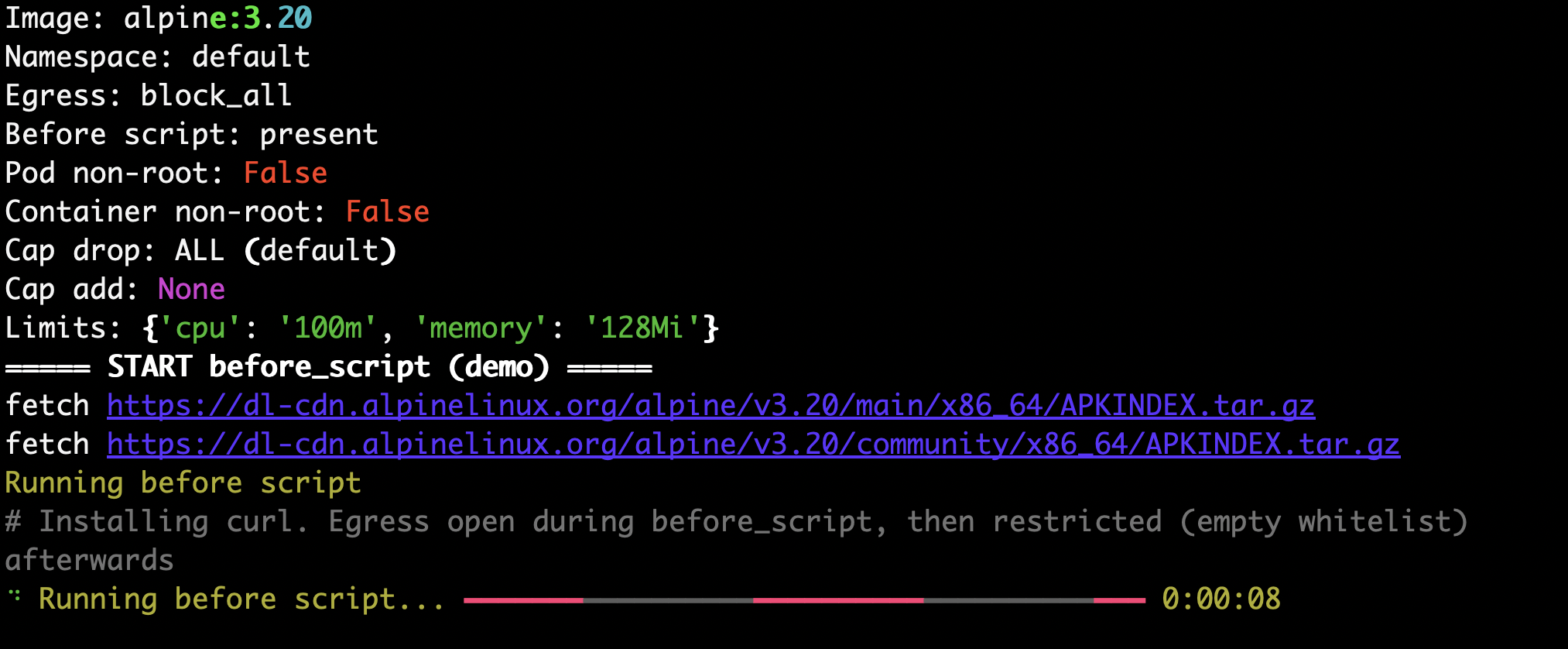
Example `k7.yaml`:
```yaml theme={null}
name: demo
image: alpine:3.20
namespace: default
env_file: /root/secrets.env
limits:
cpu: "100m"
memory: "128Mi"
before_script: |
# Installing curl. Egress open during before_script, then restricted (empty whitelist) afterwards
apk add curl
echo $ENV_VAR_1
egress_whitelist: []
```
### Create a sandbox
```bash theme={null}
# Uses k7.yaml in the current directory by default
k7 create
```
* Ensure your user is in the `docker` group to manage the API containers.
* API keys are stored at `/etc/k7/api_keys.json` by default. Authentication accepts `X-API-Key` header or `Authorization: Bearer `.
## Create your first sandbox via CLI
Example `k7.yaml`:
```yaml theme={null}
name: demo
image: alpine:3.20
namespace: default
env_file: /root/secrets.env
limits:
cpu: "100m"
memory: "128Mi"
before_script: |
# Installing curl. Egress open during before_script, then restricted (empty whitelist) afterwards
apk add curl
echo $ENV_VAR_1
egress_whitelist: []
```
### Create a sandbox
```bash theme={null}
# Uses k7.yaml in the current directory by default
k7 create
```
 ### Shell into your sandbox
```bash theme={null}
k7 shell demo
```
### Shell into your sandbox
```bash theme={null}
k7 shell demo
```
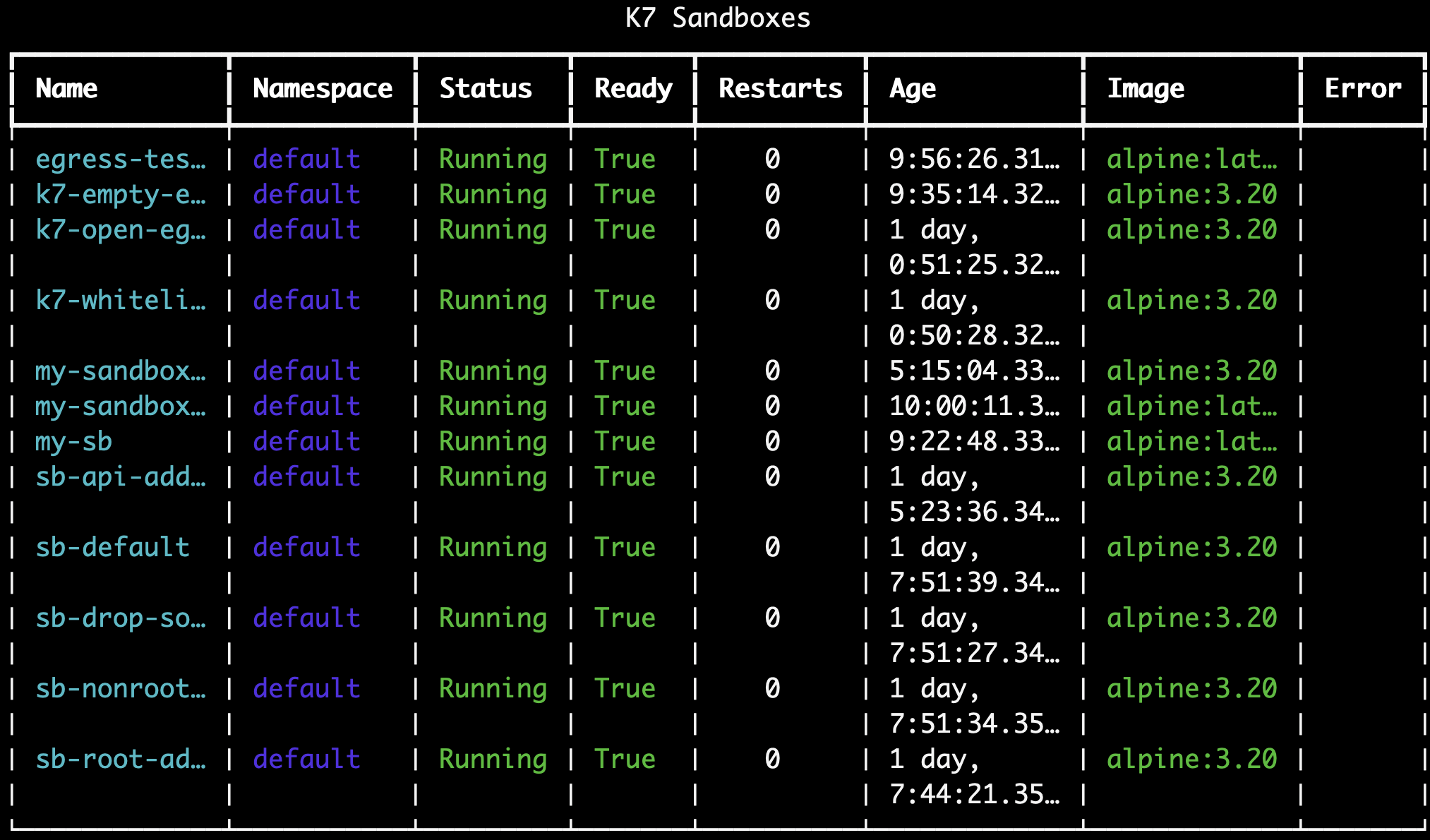
 ### List sandboxes
```bash theme={null}
k7 list
```
### List sandboxes
```bash theme={null}
k7 list
```
 ### Delete a sandbox
```bash theme={null}
k7 delete my-sandbox-123
```
### Delete all sandboxes
```bash theme={null}
k7 delete-all
```
### Prerequisites for the SDK
```bash theme={null}
# Ensure the API is running and you have an endpoint and API key
k7 start-api
k7 get-api-endpoint
k7 generate-api-key my-key
```
## Create your first sandbox via Python SDK
Install the SDK on your client machine:
```bash theme={null}
pip install katakate
```
Use the synchronous client:
```python theme={null}
from katakate import Client
k7 = Client(endpoint="https://", api_key="")
# Create sandbox
sb = k7.create({
"name": "my-sandbox",
"image": "alpine:latest"
})
# Execute code
result = sb.exec('echo "Hello World"')
print(result["stdout"]) # or just print(sb.exec("echo hi"))
# List and cleanup
print(k7.list())
sb.delete()
```
Async variant:
```python theme={null}
import asyncio
from katakate import AsyncClient
async def main():
k7 = AsyncClient(endpoint="https://", api_key="")
print(await k7.list())
await k7.aclose()
asyncio.run(main())
```
## Next steps
* Explore the CLI guide: `/guides/cli`
* Explore the Python SDK guide: `/guides/python-sdk`
* Integrate with the REST API: `/api/introduction`
### Delete a sandbox
```bash theme={null}
k7 delete my-sandbox-123
```
### Delete all sandboxes
```bash theme={null}
k7 delete-all
```
### Prerequisites for the SDK
```bash theme={null}
# Ensure the API is running and you have an endpoint and API key
k7 start-api
k7 get-api-endpoint
k7 generate-api-key my-key
```
## Create your first sandbox via Python SDK
Install the SDK on your client machine:
```bash theme={null}
pip install katakate
```
Use the synchronous client:
```python theme={null}
from katakate import Client
k7 = Client(endpoint="https://", api_key="")
# Create sandbox
sb = k7.create({
"name": "my-sandbox",
"image": "alpine:latest"
})
# Execute code
result = sb.exec('echo "Hello World"')
print(result["stdout"]) # or just print(sb.exec("echo hi"))
# List and cleanup
print(k7.list())
sb.delete()
```
Async variant:
```python theme={null}
import asyncio
from katakate import AsyncClient
async def main():
k7 = AsyncClient(endpoint="https://", api_key="")
print(await k7.list())
await k7.aclose()
asyncio.run(main())
```
## Next steps
* Explore the CLI guide: `/guides/cli`
* Explore the Python SDK guide: `/guides/python-sdk`
* Integrate with the REST API: `/api/introduction`